top of page

Our research

The LRRG is focused on bringing forward research, evidence and policy ideas that will help unlock the potential of our rural communities while highlighting the challenges our rural communities face.

Call for evidence:
The Future of the Rural Economy


Submission deadline: 

6th May 2026 

The Labour Rural Research Group (LRRG) has opened its latest call for submissions to inform our upcoming report examining the future of the rural economy.


Rural areas are fundamental to the UK’s economic, social and environmental success. Home to distinctive industries, deep expertise and a highly skilled workforce, they hold significant untapped potential — yet structural barriers continue to constrain their ability to thrive, scale and attract investment. As such, this report will assess the current state of the rural economy and take a forward-looking view to 2040, with a particular focus on the actions needed during the current parliament to unlock long-term growth, resilience and opportunity.


The research will build on existing evidence and analysis while bringing together fresh research, practical experience and Labour MPs’ perspectives to produce a coherent and forward-looking set of recommendations for government. The study will cover rural areas across England, Scotland, Wales and Northern Ireland, recognising different devolved policy contexts while identifying shared challenges and opportunities.


We are therefore inviting individuals, businesses, community organisations, charities, local authorities, academics, sector bodies and service providers to submit evidence and insights to inform the study. Evidence should consider:


  1. Economic activity, productivity and growth – performance across key rural sectors including agriculture, energy, tourism, manufacturing, services and emerging industries; rural productivity gaps; opportunities for diversification and innovation.​

  2. Small and micro-businesses and entrepreneurship – access to finance and business support; planning and regulatory barriers; community, cooperative and social enterprise models; supporting high-value and emerging sectors.​

  3. Business tax environment and investment – impact of the tax framework on rural businesses, land use and investment; effectiveness of incentives such as capital allowances, business rates relief and R&D tax credits; role of business rates and property taxation for diversified and land-based enterprises; barriers to diversification into sectors like tourism, energy and natural capital; opportunities for reform to better reflect rural economic conditions.

  4. Workforce, skills and demographics – education and skills provision; labour supply; retention of young people; ageing populations; remote and hybrid working and its implications for rural growth.​

  5. Infrastructure and connectivity – digital connectivity; transport and accessibility; energy and utilities; infrastructure priorities with the greatest economic and social returns for rural communities.​

  6. Housing and labour markets – affordability, availability and quality of housing; impacts of second homes and short-term lets; planning mechanisms and their relationship to workforce retention and community sustainability.​

  7. Land use and the environmental economy – farming and agricultural policy; nature restoration; climate mitigation and adaptation; renewable energy; balancing land-use priorities while supporting rural livelihoods.​

  8. Public services and access to opportunity – access to health, education, transport and childcare; rural and coastal service gaps; funding formulas; place-based and digital service delivery models.


Submission must take the form of written evidence, and can be case studies, research summaries or qualitative reflections. We welcome data and statistics where this is available. Both organisational and individual contributions are welcome.


Submission can be made directly by emailing: info@labourruralresearchgroup.com

Front pagr.png

Rural Poverty in Britain

Our latest report draws on evidence from councils, NHS bodies, charities, rural businesses and rural residents - as well as focus groups commissioned exclusively for the LRRG - and finds a consistent pattern: rural households are expected to travel further, pay more and rely on fewer alternatives, yet national funding and service models continue to assume urban density, economies of scale and proximity to services.

​

In March 2026, the LRRG set out 24 recommendations centred on a comprehensive Rural Strategy that address the root causes rather than symptoms of hardship; going beyond isolated interventions or “rural add-ons”.


All findings and recommendations are now available in the full report and executive summary.

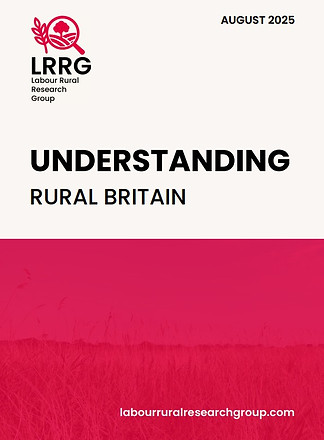
Understanding Rural Britian

Our first report revealed the shifting political dynamics in rural Britain following Labour’s historic 2024 General Election victory. ​


Based on a survey of over 1,400 rural voters conducted between 30 June and 14 July 2025, 'Understanding Rural Britain' sets out the issues, identities and expectations shaping the political landscape across the UK’s countryside.

​

Read the full report.

first report lrrg.jpg
bottom of page